
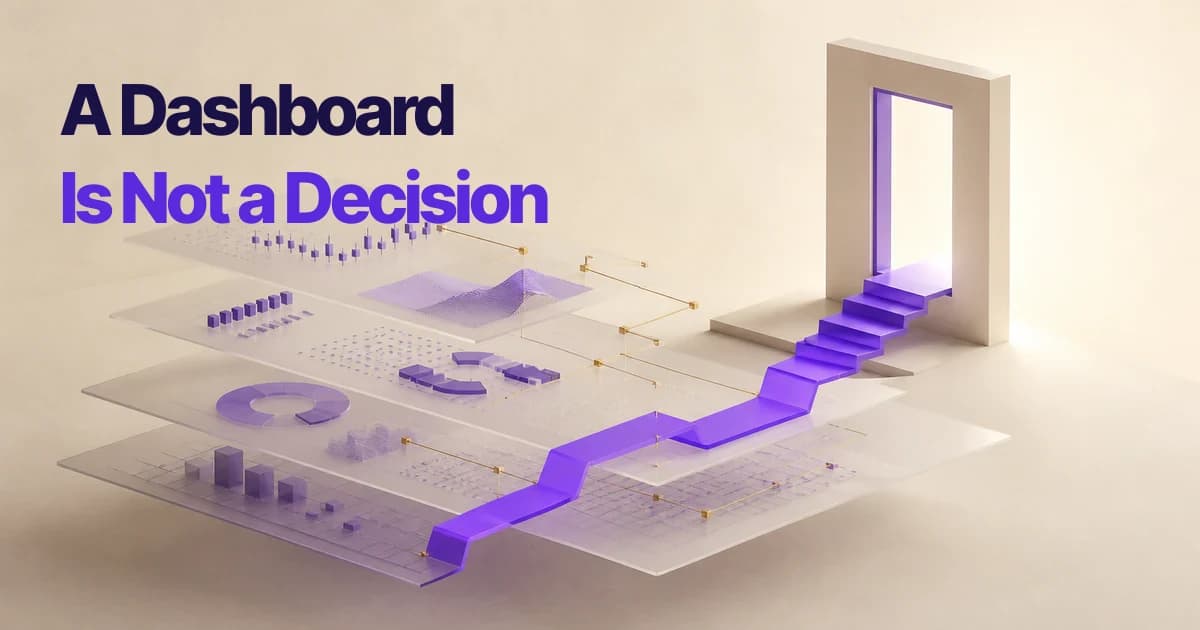
Business owners do not need more reports. They need better visibility.
That sounds like an argument for dashboards, but the dashboard is only the middle of the process. A dashboard can organize information beautifully and still leave the leadership team unsure what to do next.
The test is not whether the numbers are visible. The test is whether the numbers change a decision while there is still time to act.
Reporting and visibility are different jobs
A report usually answers a historical question: what happened during the period? That answer matters. The books should close accurately, revenue and expenses should be classified correctly, and the leadership team should have a reliable record.
Visibility answers a more immediate question: what is moving now, why is it moving, and which decision does that movement require?
The difference is function, not formatting. Moving a monthly report into colorful charts does not make it forward-looking. Adding more metrics does not make it useful. In fact, a larger dashboard can create a false sense of control. Everyone sees activity, but no one knows which signal deserves attention.
A useful dashboard is intentionally incomplete
Most growing businesses have more available data than they can use in one leadership meeting. The discipline is choosing the small group of metrics that explain the operating model.
Those metrics will differ by company, but the selection process should be consistent:
The metric changes before the financial outcome changes.
A named person can influence it.
Leadership knows the expected range.
Movement outside that range triggers a defined question or action.
The metric can be read alongside the other drivers instead of in isolation.
A service business might connect qualified pipeline, close rate, delivery capacity, gross margin, collection timing, and cash runway. The value is not in seeing six numbers. The value is in understanding the sequence between them.
If pipeline softens, the cash effect may not appear immediately. If pricing changes, close rate may move before revenue quality improves. If delivery labor grows ahead of booked work, margin pressure can arrive before the bank balance makes the problem obvious.
Every metric needs a decision attached to it
Before adding a KPI to a leadership dashboard, finish this sentence: “If this number moves beyond the agreed range, we will…”
If nobody can complete the sentence, the metric may be informative, but it is not yet part of the decision system.
This does not mean every variance demands an immediate correction. Sometimes the right response is to watch for another week, ask for better data, or confirm that an intentional investment is behaving as expected. The important part is that the team recognizes the movement and agrees on the response.
That is why a good monthly finance meeting should not be a guided tour of every chart. It should begin with what moved, what did not, why the difference matters, and which decision follows.
The dashboard should shorten the distance between signal and action
Lag is expensive. A problem visible only after month-end has already had time to compound. A problem discussed without an owner can survive another month. A problem with no threshold becomes a permanent debate about whether the change is meaningful.
The operating rhythm matters as much as the software:
1. Agree on the few drivers that explain the business. 2. Define expected ranges and early-warning thresholds. 3. Assign ownership for each input and response. 4. Review movement in a consistent cadence. 5. Record the decision and revisit whether it worked.
This turns the dashboard into part of management rather than a display used during management meetings.
Clarity is measured by the next move
A polished dashboard can still be passive. A plain one can be transformative if it helps the team identify a constraint early and act with shared understanding.
Do not judge the system by how much data it contains. Judge it by whether leadership can answer three questions quickly:
What changed?
Why does it matter?
What are we doing about it?
If those answers remain unclear, the business does not have a dashboard problem. It has a decision-design problem.
For more direct operator notes on financial leadership, follow Arron on LinkedIn. For longer conversations, explore the podcast and video library.